
I Flew Nuclear Missions
Here’s What Scares Me Now

“Intelligence without diplomacy is a loaded gun with no safety. You need both to prevent catastrophe.” - The Spy Archive
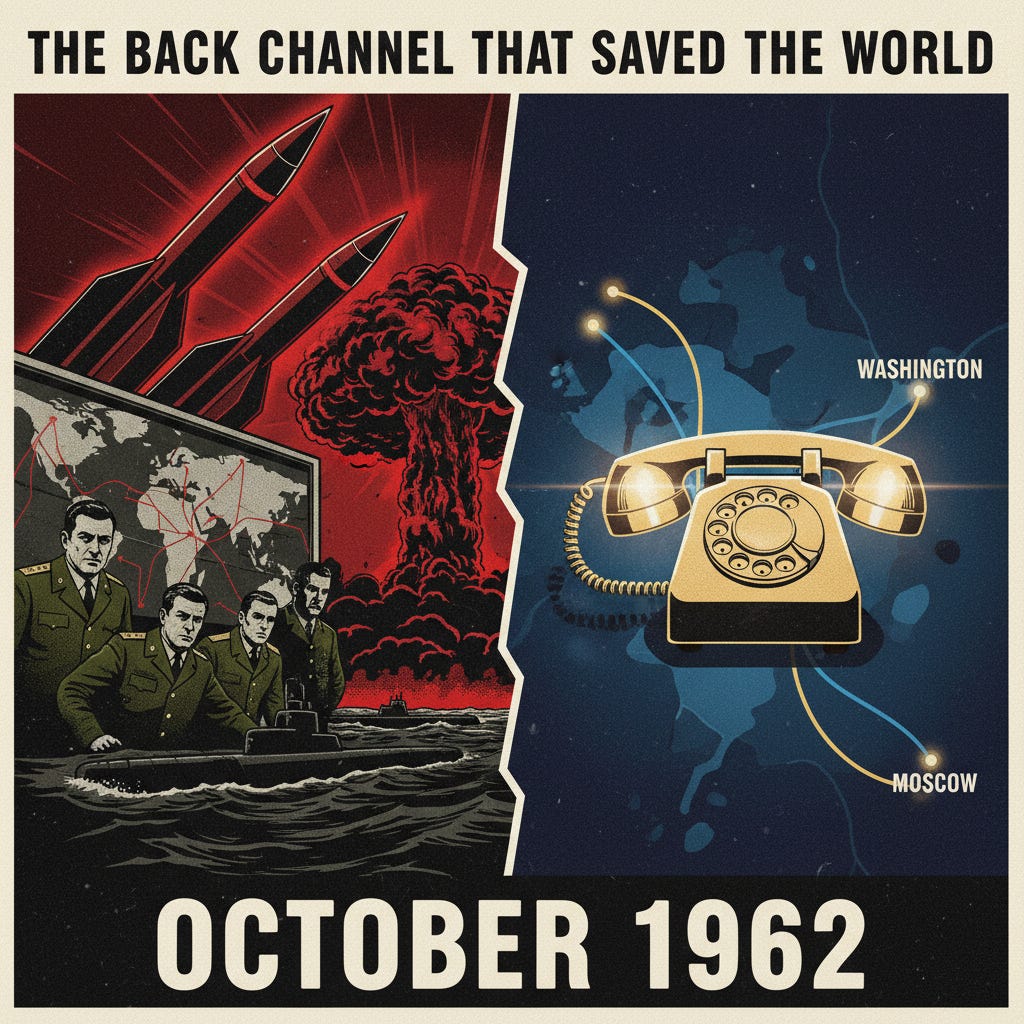
Picture this. It’s October 27, 1962. Soviet submarines armed with nuclear torpedoes are being depth-charged by American destroyers. In Cuba, a Soviet surface-to-air missile has just shot down a U-2 spy plane, killing Air Force pilot Rudolf Anderson. The Joint Chiefs are pushing Kennedy for immediate air strikes and invasion.
The world is hours from nuclear war.
But here’s what the generals don’t know. There’s a secret back channel operating between the White House and the Kremlin. Attorney General Robert Kennedy has been meeting quietly with Soviet Ambassador Anatoly Dobrynin. British intelligence has connected Washington and Moscow through a KGB officer in London. Journalists are passing messages that can’t go through official cables.
These informal conversations will save hundreds of millions of lives.
Why Back Channels Actually Matter
Back channels aren’t surrender. They’re survival.
Here’s what happened: Bobby Kennedy walks into the Soviet Embassy. No cameras. No press. Just him and Dobrynin in a room. And he can say things the President can’t say publicly. “Here’s what we can live with. Here’s what gets people killed.” No posturing. No playing to Congress or Moscow hardliners. Just two guys finding a way out.
They even worked out a secret deal - U.S. pulls missiles from Turkey, but nobody can know about it or Khrushchev looks like he caved to threats. That’s the kind of solution you can’t do with CNN watching.
The result? The missiles left Cuba. War was averted. The world kept spinning.
Why This Gets Personal
In the 1990s, I flew E-6 TACAMO missions - Take Charge And Move Out. Nuclear deterrence. Our job was to make sure communication could survive even in the worst possible scenario.
Every mission drove home the same truth: we’re one mistake away from the end. And being part of that system taught me something important: all the hardware and procedures in the world aren’t enough. Your only real hope is that someone, somewhere, finds a way to stop things before the system ever has to work.
That’s why watching us dismantle our diplomatic infrastructure isn’t just frustrating to me - it’s professional malpractice.
This past January, the State Department asked some of its most experienced career experts to resign. These weren’t political appointees - they were professionals with decades of experience and relationships in places where trust takes years to earn. Just gone.
We’re treating diplomacy like it’s optional. And we’re learning the hard way that relationships can’t be rebuilt overnight when you need them.
Where We’re Playing With Fire Now
U.S.-China relations are more dangerous than at any time since normalization. A Chinese spy balloon drifts over Montana, and we shoot it down and cut off high-level military communication. A balloon. We cut off military communication with a nuclear power over a balloon. When a Chinese warship and American destroyer nearly collide in the Taiwan Strait, there’s no immediate back channel to de-escalate.
In October 1962, Kennedy and Khrushchev at least had multiple ways to talk. Today, the U.S. and China are nuclear powers with increasing tensions over Taiwan, and we’ve let communication channels atrophy.
North Korea has conducted over 100 missile tests since 2022. We have virtually no diplomatic contact with Pyongyang. No back channels. No crisis communication protocols. When Kim Jong Un launches an ICBM that could reach Los Angeles, we issue statements and conduct military exercises. What we don’t do is talk.
This is exactly how wars start by accident. Two ships playing chicken in the Taiwan Strait. A nervous commander. A miscalculated move. And nobody to call who can say “Stand down, we’re working on it.”
The Choice We’re Making
Here’s what Kennedy understood that we seem to have forgotten: preventing war requires different tools than winning war.
Military power is essential - it’s what gave Kennedy leverage to negotiate from strength. But military power alone couldn’t solve the crisis. That required communication, trust-building, and giving your adversary a way to back down without humiliation.
And look, I get it. Prevention isn’t sexy. It doesn’t make headlines. You can’t point to the war that didn’t happen and claim victory. But that’s the whole point, isn’t it?
The back channels that saved the world in October 1962 didn’t appear overnight. They were built through years of investment in diplomatic relationships, intelligence sharing, cultural understanding, and yes, talking to our adversaries.
We can rebuild that infrastructure. We can invest in the State Department, fill critical diplomatic positions, fund prevention programs, and maintain communication channels even with countries we oppose.
Or we can continue down our current path, confident that military power alone will keep us safe, until the day it doesn’t.
Kennedy made his choice in October 1962. He chose diplomacy backed by strength. He chose prevention over assumption. Sixty-three years later, we’re making ours.
Let’s hope we’re as wise as he was.
Paid subscribers can read the full analysis, including detailed examples of where we’re at risk today in Ukraine, Iran, and the Middle East, plus what history teaches us about prevention.
Dexter Ingram is the author of “The Spy Archive: Hidden Lives, Secret Missions, and the History of Espionage” and former Director of the Office of Countering Violent Extremism at the U.S. Department of State. Subscribe to Code Name: Citizen for more insights on intelligence, prevention, and national security.