

Operation Cornflake: The Stamp That Killed Hitler
The OSS forged Hitler's face onto a postage stamp with his skull showing – then conned the Nazi post office into hand-delivering it before breakfast.

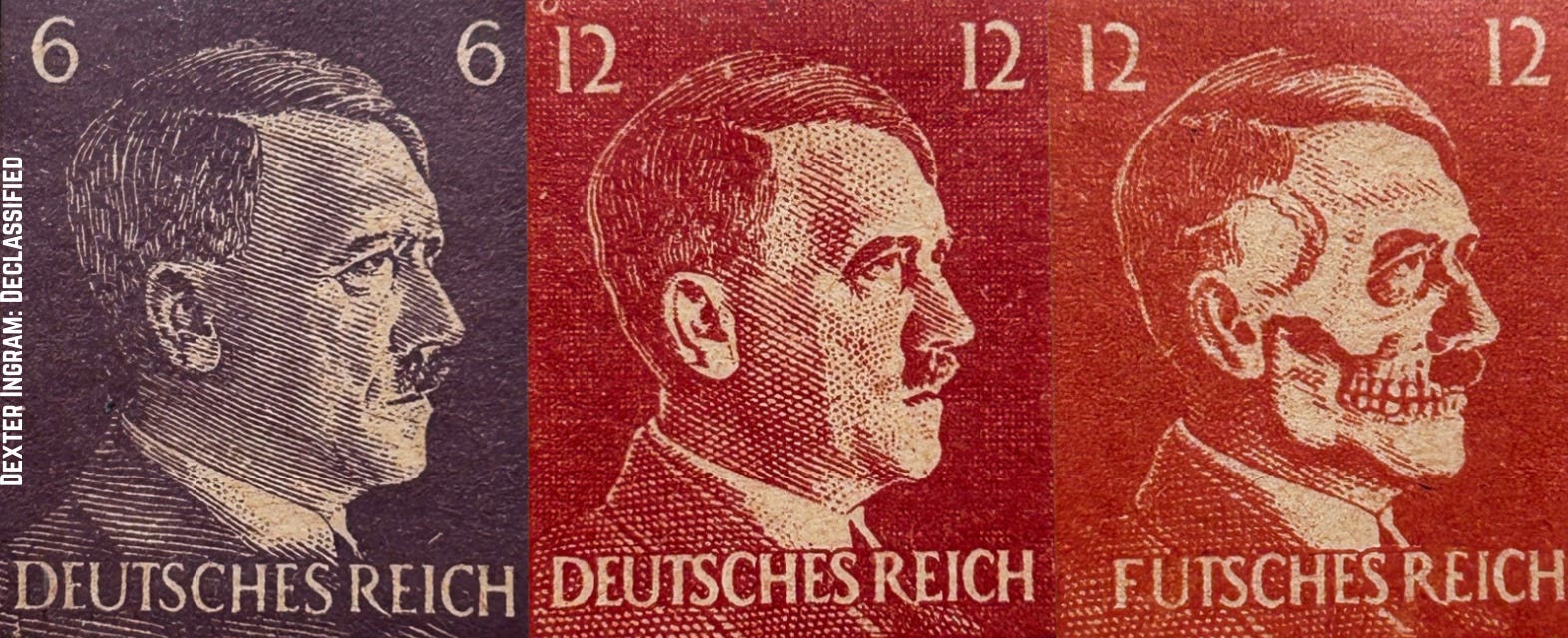
Somewhere in Austria in the spring of 1945, a German sat down with his morning mail and found Adolf Hitler staring back at him with half his face rotted off.
It was a postage stamp. Twelve pfennig – pocket change, the German equivalent of a first-class stamp – and the same one he’d licked a hundred times, except the Führer’s cheek had been eaten away to the bone and the jaw was grinning at him. Along the bottom, where every German stamp read Deutsches Reich, this one read Futsches Reich. Swap a letter, drop another. German Empire becomes ruined empire.
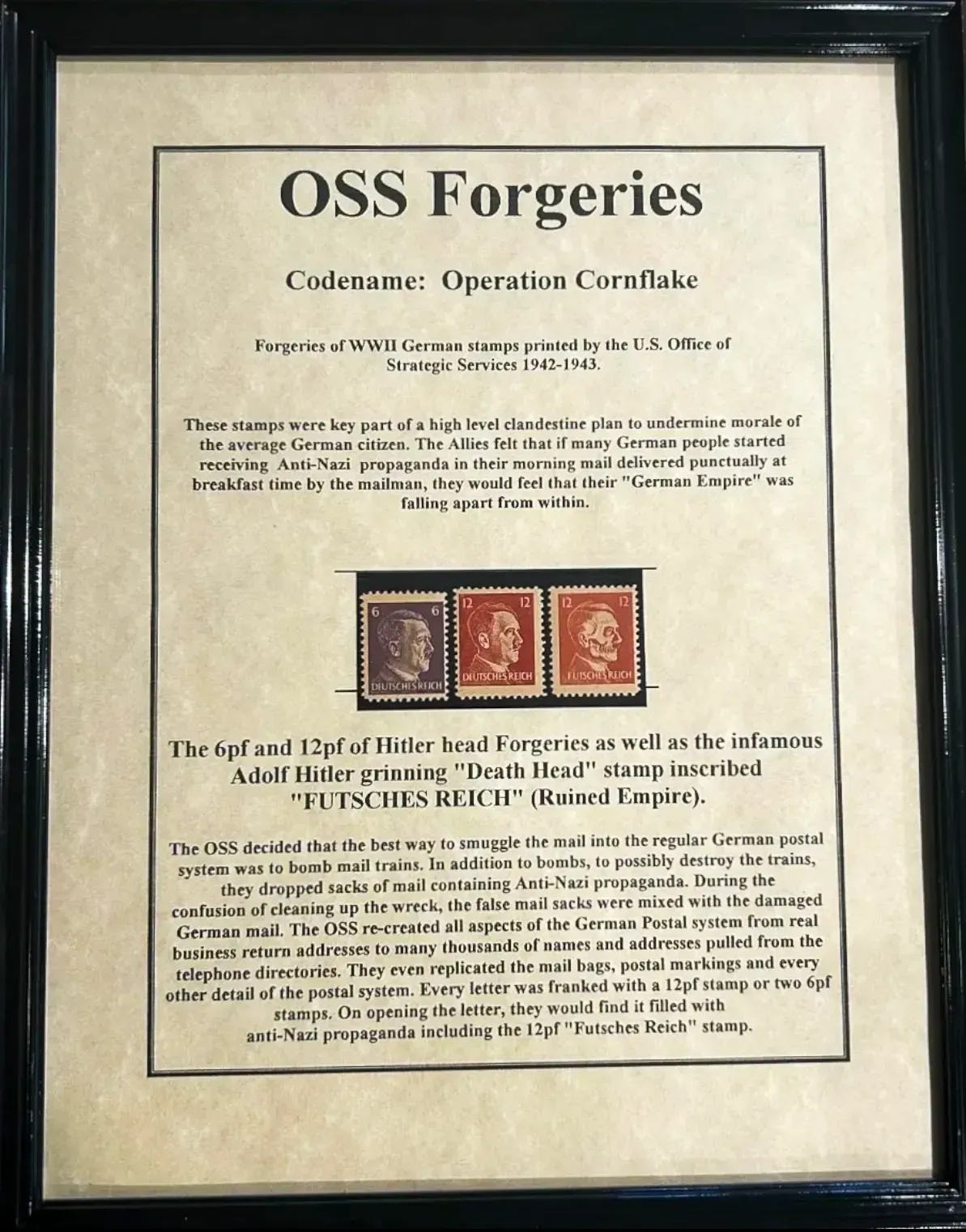
I keep one framed downstairs. Pound for pound it’s the best piece of graphic design any American intelligence officer has ever put on paper.
And the Nazi postal service delivered it. On time. To the front door.
Leaflets blow away. Mail doesn’t.
This was the Office of Strategic Services, our wartime spy shop and the outfit CIA grew out of. Specifically Morale Operations, the black propaganda branch, whose whole job was convincing Germans the war was already lost.
MO had good material and no way to deliver it. Leaflets dropped from aircraft blew into rivers, landed in empty fields, turned to pulp in the rain. And anything that flutters out of the sky tells you immediately who sent it and why.
So they asked a better question. Who is already carrying paper to every German doorstep before breakfast?
They called it Operation Cornflakes, because that’s when the mail showed up.
Shoot the train, then mail the train
February 5, 1945. A flight of P-38s came in low over the rail line north of Linz and shot a mail train to pieces. Locomotive destroyed, twelve freight cars torn open, mail scattered all over the wreck.
Then the second wave came around and dropped eight bags of mail into the smoke.
Not bombs. Mail. Canvas Reichspost sacks holding about three thousand letters, every one addressed to a real German at a real address, stamped, cancelled, ready to go. When the postal crews showed up to clean the site, they gathered the fake sacks along with the real ones and finished the route.
They ran that play roughly ten times between February and April. About 320 bags. Somewhere near 96,000 letters moving through the German mail, carried by German postmen, on the Reich’s dime.
The boring stamp did the heavy lifting
The skull couldn’t go on the outside of the envelope. Any clerk would’ve caught it in half a second.
So the OSS forged the ordinary Hitler stamps too, the everyday ones in every German desk drawer, and made them perfect. Right engraving, right perforation, right color, right cancellation, correct postage for the class of mail. Dull on purpose. Those rode on the outside so the letter sailed through the sort.
Then they kept going, because the mail had to survive a second look. Return addresses lifted from real German businesses out of prewar phone books. Recipient names harvested by the thousand. A believable mix of typed and handwritten envelopes, because real mail is never uniform. They even reproduced the mail sacks down to the weave of the canvas.
All that work so one man could open an envelope at his kitchen table and find a dead Hitler grinning up at him.
One clerk, one typo, game over
Somebody in the addressing shop, hours into a shift with a cramping hand, wrote Cassenverien instead of Kassenverein. More than once.
A postal clerk caught it and kicked it upstairs. They opened the envelopes, found the propaganda, and the hunt was on.
Months of forgery, engraving and air planning, and the thing came apart on a misspelled bank name. That story’s been told a hundred times and traces mostly through secondary accounts. I believe it. I can’t prove it.
Eighty years old, still running
Cornflakes worked for one reason. It arrived by a route the target already trusted. Everything else was in service of that.
Nothing about that has aged. The message is cheap now, cheaper than it has ever been. Renting somebody else’s credibility to carry it is still the expensive part, and it’s still where the real work goes.
So the payload rides in the family WhatsApp group, because an uncle never gets fact-checked. Bot accounts post about football and traffic and the weather for six months before they ever mention an election, and those six months are the boring stamp. The most valuable fake isn’t a fake candidate, it’s a fake local news site with a decent masthead, a season of real city council coverage, and one story that isn’t true.
Same operation. The OSS needed a bomber wing and an engraving shop. Today it needs a laptop.
⏳ One more thing: we extended the annual subscription promo until tomorrow. A year of Declassified, plus one of my books – your choice, signed, dedicated, and mailed to your door. Every dollar funds IN Network, which is how young people end up in rooms like the one in that last photo. This is the last weekend!
Dexter Ingram spent more than 30 years in national security – State Department, INTERPOL in Lyon, Helmand Province, and an 89-nation coalition against ISIS. He wrote two Amazon #1 New Releases, The Spy Archive and National Security Careers, and keeps one of the largest private intelligence collections outside a government vault – which is exactly where The Collection comes from.
Incredible piece of history
Thanks for this history. I am sure that I am being duped daily on this phone. There is just so much information pouring in that discriminating truth from fiction, especially from those whom you only interact with on here, is impossible. I did once catch a fake email sent to me, allegedly from a childhood friend. It was totally credible until it wrote about feeling sad about a mutual boarding school attendee, Ghislaine Maxwell. Except that Maxwell did not attend our school. I almost pitied the fool who wrote it. Almost.