


You’re on a sidewalk in Europe, sometime between 1905 and the war. A man stops a few feet ahead of you and checks his watch. He holds it a second or two longer than he needs to, drops it back in his vest, and keeps walking.
You don’t look twice. Nobody would. That’s the point.
He just took your picture.
Or, depending on which watch he’s carrying, he just enciphered a message about you, and there’s nothing in his pockets that would prove it.
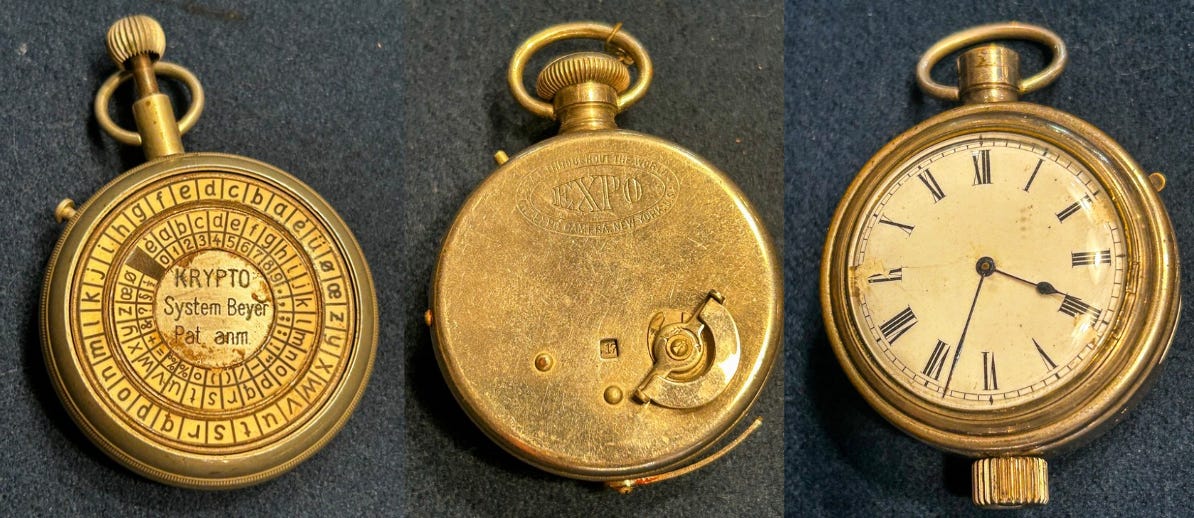
I’ve got three of them on my shelf. Two are cameras. One’s a cipher machine. None of them keep time.
Everybody understands the easy half of a spy gadget. Hide the camera in the watch. Every spy movie gets that far. The hard part comes after, when somebody has to work the thing in daylight, in a crowd, with his hands out where anyone can see them.
All three of these were built for the hard part.
The dial is the disguise, not the instrument
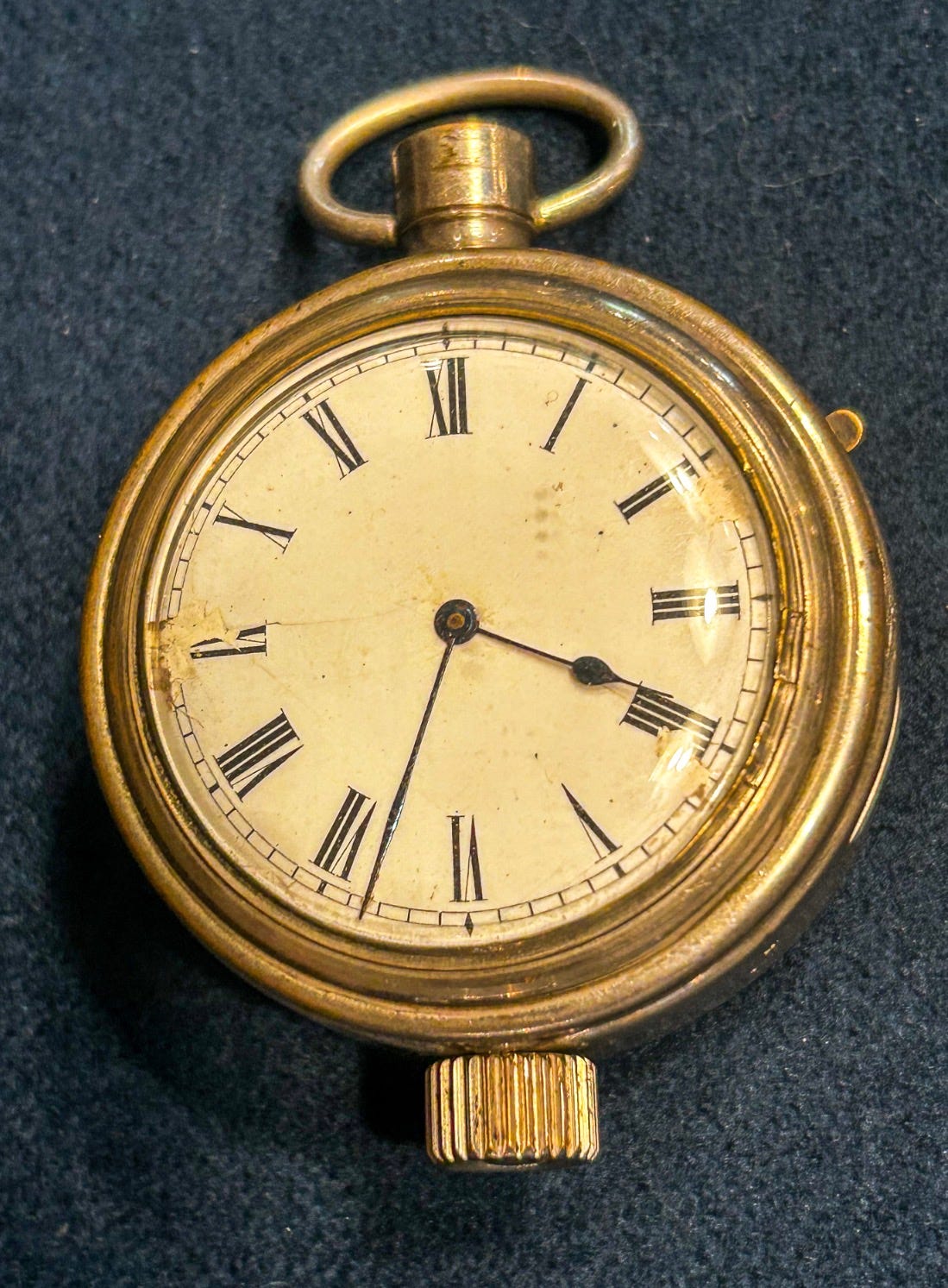
Put one of these in your hand and I can tell you exactly what you’ll do. You’ll hunt for the lens. Then you’ll want to know how you actually take the picture. You won’t ask about the dial. Nobody ever does.
Which is exactly what the dial is for.
There’s nothing behind it. No mainspring, no gears, nothing in that case that has ever kept time. And it isn’t there for the man carrying it, because he knows what’s in his hand. That face is for the man across the street. It’s the only part of the thing aimed at a bystander instead of a target.
Here’s your lens, by the way. It’s the small knob at the top edge of the case, capped to pass for a winder. Aiming is no mystery. You point the top of the watch at whatever you want and press the release.
Collectors will tell you the hands were fixed in that V to show the camera’s angle of view. Maybe. Having held one, I’m skeptical it did much for anybody. The V is a good deal wider than the lens actually takes in, and you’d be estimating either way.
What the dial absolutely does is buy the man holding it four or five seconds of nobody caring. That’s worth more than any lens.
Checking your watch is about the only thing you can do in public while standing still, staring down, concentrating hard, and working a mechanism with both hands, and have nobody wonder what you’re up to.
The camera is disguised as a watch. The spy is disguised as a man who’s late.
This one’s a Ticka, made by Houghtons of London and out of production by 1914.
Twenty-five shots and a doorway
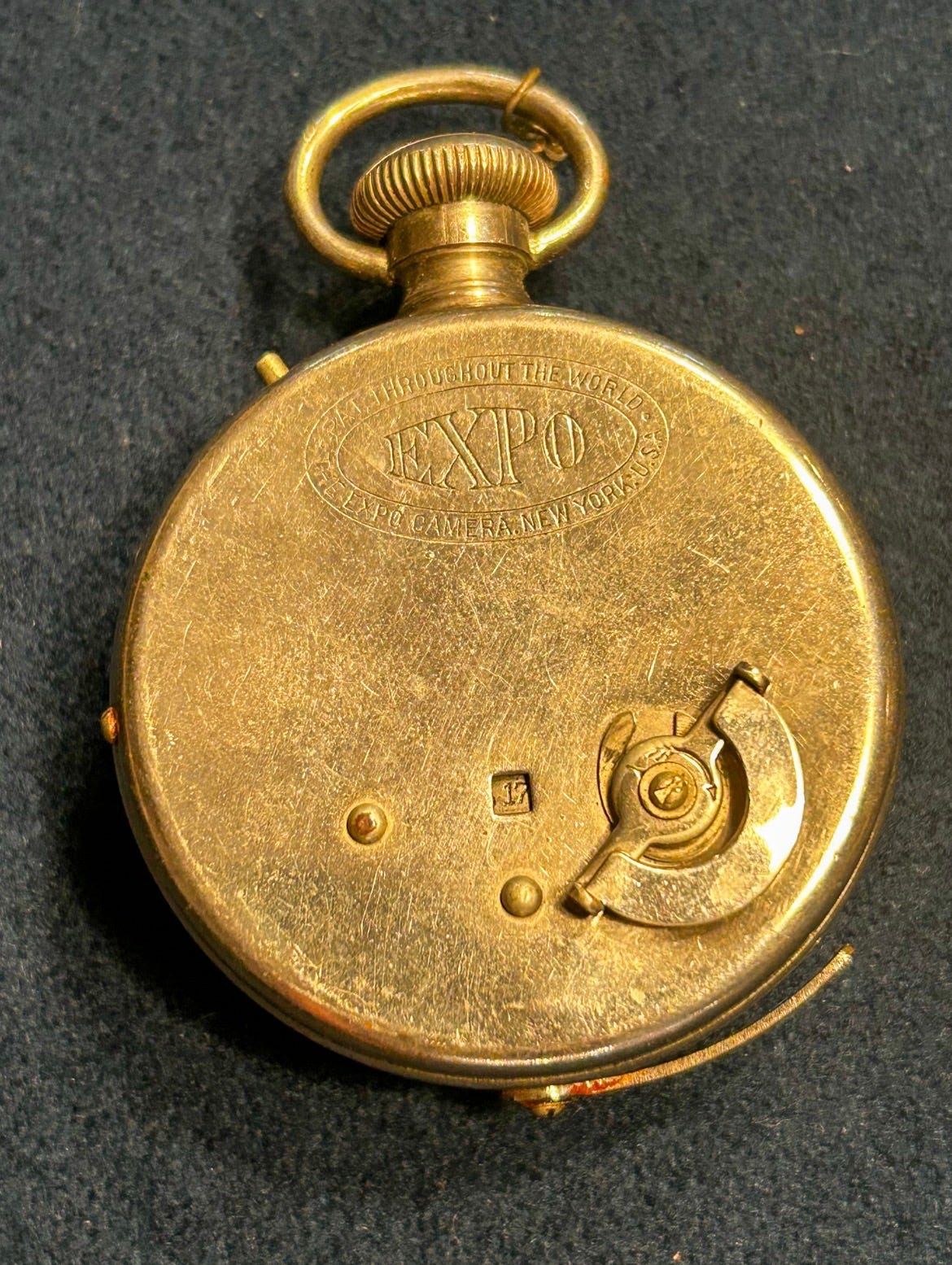
The American cousin. Same Swedish designer, patented in the United States in 1904, sold out of New York into the late 1930s. A spy camera with a thirty-year production run tells you something about how well the idea worked. Mine still carries the oval on the back: patented throughout the world, The Expo Camera, New York, U.S.A.
The feature that mattered is the one that sounds like nothing. The film came in a cassette you could change in broad daylight.
No darkroom. No changing bag. No hunting for a windowless room in a city where you don’t know a soul and can’t afford to ask. Twenty-five frames, then you reload on a park bench and go back to work.
Concealment gets you to the target. Daylight reloading is what lets you stay.
Nothing to burn
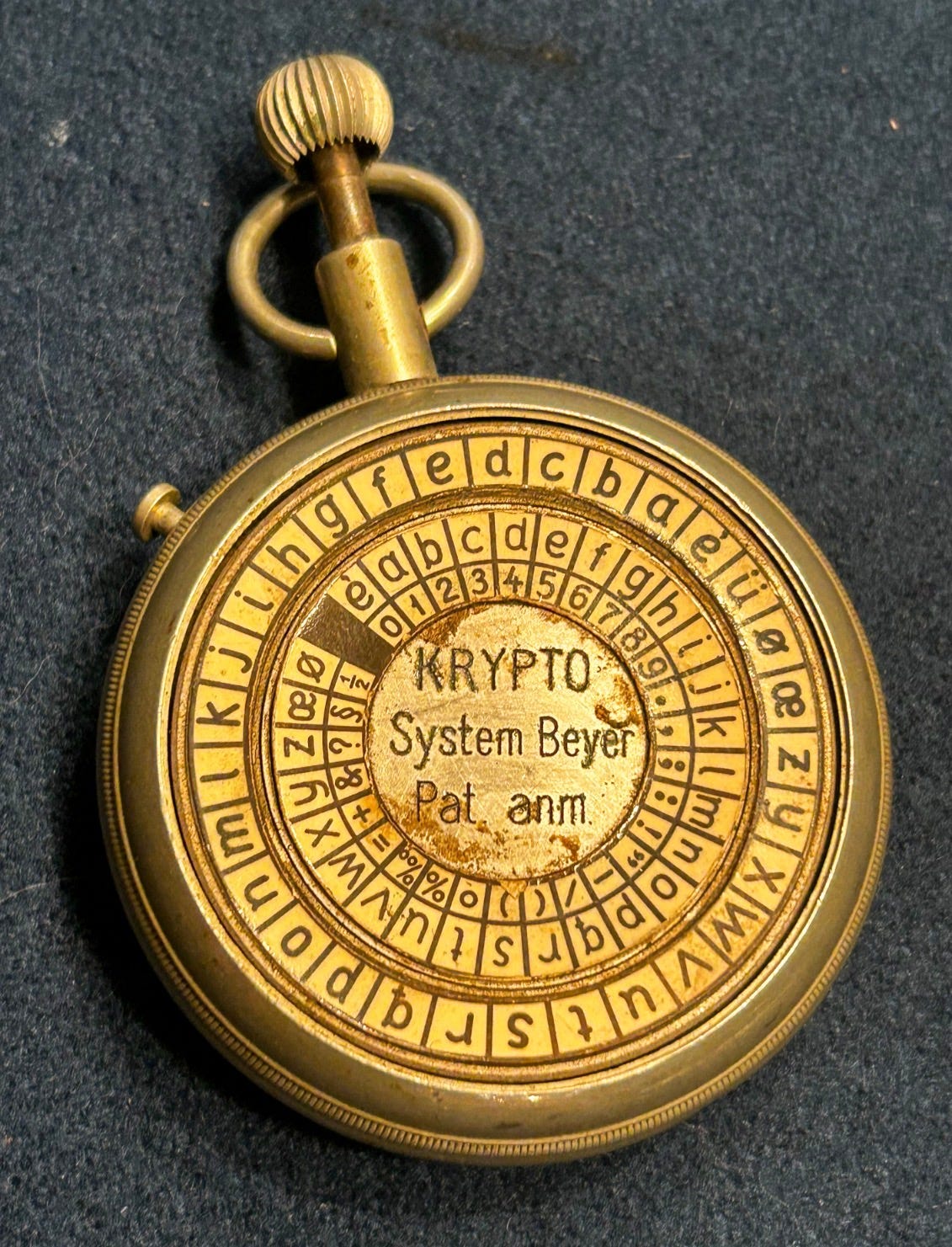
The third one is the piece almost nobody has held. Same bow, same knurled crown, no lens and no film. What’s under the crystal is a cipher machine.
KRYPTO System Beyer. Danish, early 1930s, out of Copenhagen. Two alphabet rings, an inner ring of figures and punctuation, springs driving the discs against each other, a plunger to trip the release. The extra Danish letters riding at the tail of the alphabet tell you where it came from before any paperwork does.
It sold on one promise. No more code books.
If you’ve never had to work that problem, that sounds like a convenience. It isn’t. The code book is the thing that gets people killed. It’s bulk. It’s paper. It burns slowly and badly, and there’s no talking your way past it. Get stopped with a code book and you’re finished. Get stopped with a pocket watch and you’re a man with a pocket watch.
That’s the part people miss about espionage gear. This device didn’t have to beat a cryptanalyst. It had to beat a search.
About half a dozen are known to survive anywhere in the world. One of them is in my house.
What all three of them knew
Two countries, three decades, designers who never met, and every one of them landed on the same object.
Not because a watch is small, though it is. Because a man looking at his watch is invisible.
Dexter Ingram spent more than 30 years in national security – State Department, INTERPOL in Lyon, Helmand Province, and an 89-nation coalition against ISIS. He wrote two Amazon #1 New Releases, The Spy Archive and National Security Careers, and keeps one of the largest private intelligence collections outside a government vault – which is exactly where The Collection comes from.
Ok. I can't resist sharing a story. I was studying IR in San Francisco in the mid 1980s when Gorbachev introduced Glasnost and Perestroika. Macy's SF was reportedly the first business in the U.S. to import a Soviet product. It was a watch. It has a large white face with black numbering and a brown leather band stamped CCCP. The brand marking on the face reads "PAKETA" in Russian letters. I am told it means "rocket". So, the CCCP sent it's first Soviet product to the US to Macy's SF and it is labeled rocket? A little Soviet humor, I guess. Thanks for the great posting, Dexter! Such clever devices. I am already learning to see a bit differently.
This was very cool to read & learn