

Striking Secrets | The Matchbox Cameras
It fit in your palm, shot 34 photos, and had to be loaded in total darkness. The enemy never knew it existed.

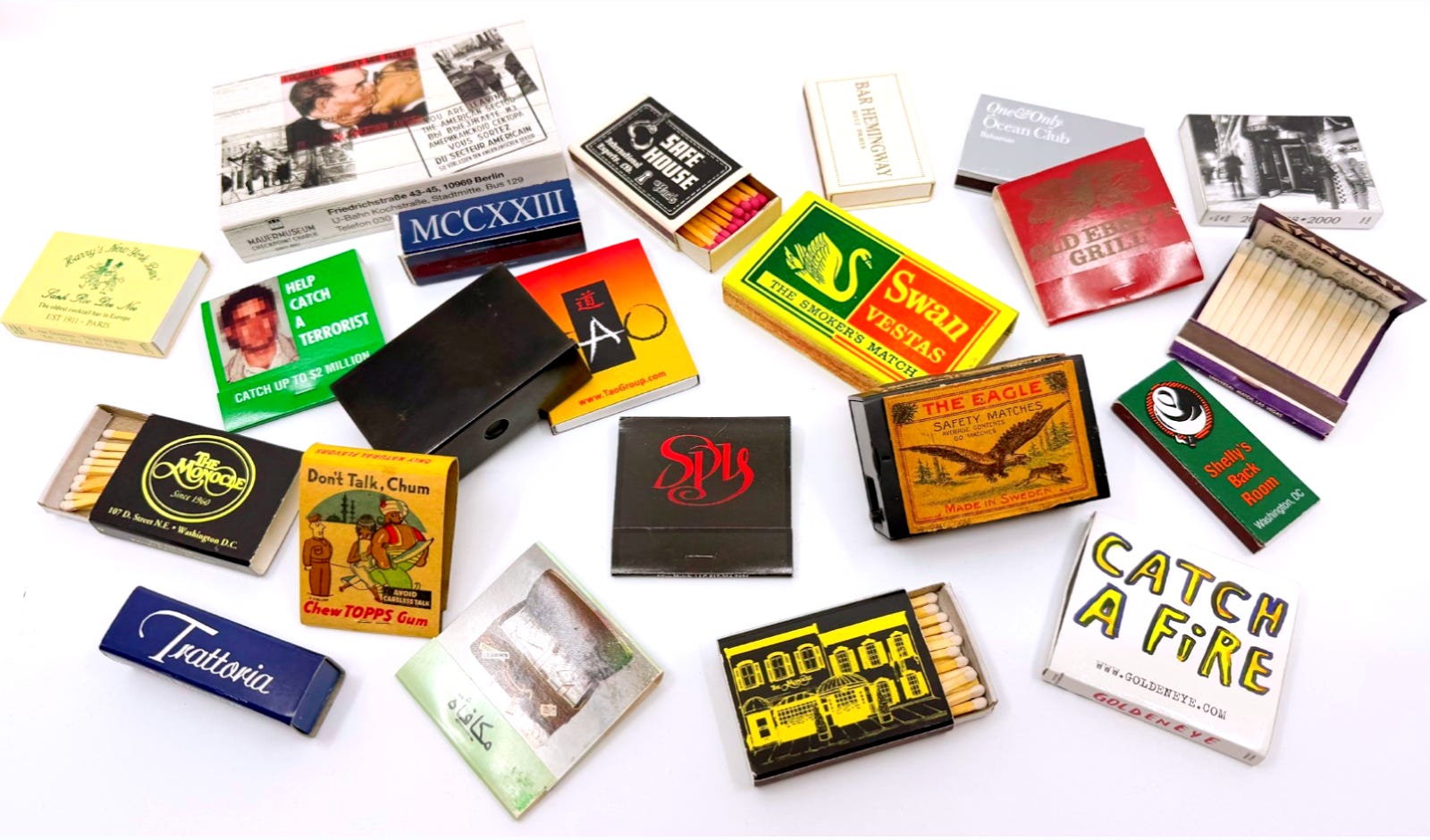
Somewhere in this photo are two matchboxes that are not matchboxes.
Picture yourself at a checkpoint in Occupied France, 1944. A German soldier scans you top to bottom. In your jacket pocket sits a box of matches. He waves you through. What he missed could change the course of the war.
Eastman Kodak built two covert cameras for the OSS that year, each designed to disappear inside a standard wooden matchbox. They called one Camera X and the other simply The Matchbox. Both shot 16mm film, both delivered 34 exposures per roll, and both were precise enough to photograph a face, a troop formation, or a classified document laid flat on a table.
What made them remarkable was a single engineering decision. The film had to be loaded and unloaded in complete darkness. Not dim light. Total darkness. The controls were built to work entirely by feel, no looking down, no adjusting. The OSS did not do that for convenience. They did it because they knew exactly what kind of moment their agents would be in when they needed to use one.
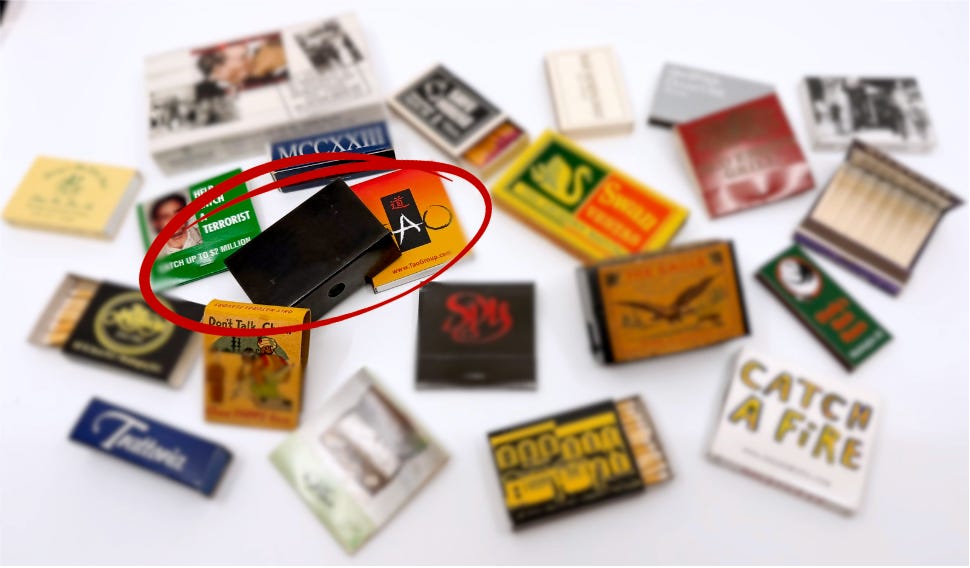
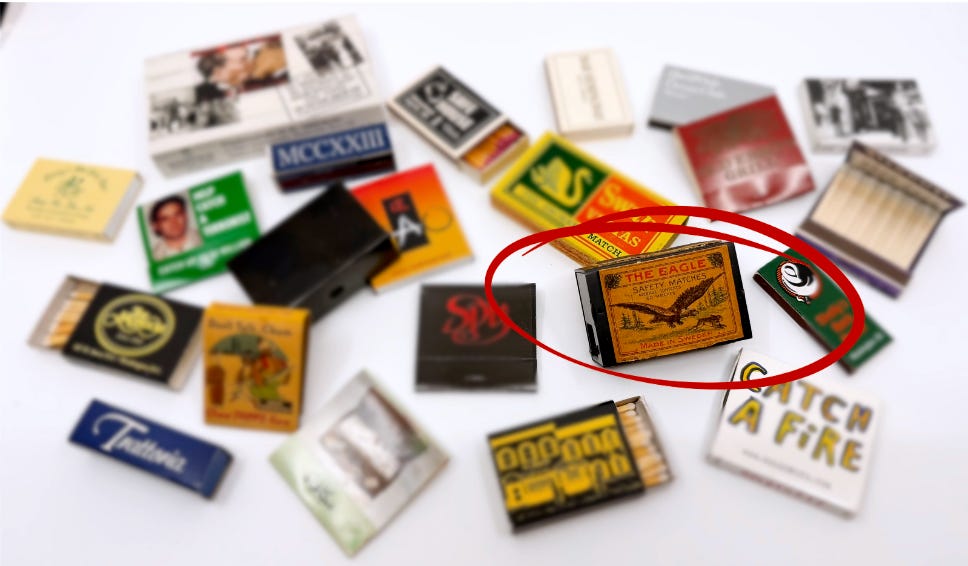
The cameras left Kodak plain. Before a mission, an OSS officer would choose a label that matched wherever the agent was going and press it to the wooden shell. That decision was that specific. The plain black Camera X you see here was either never deployed or came back without its cover. The other one, circled below, tells a different story. Its label reads “The Eagle Safety Matches,” a British brand. Someone chose that label for a reason, for a place, for a person. That cover was the difference between blending in and being caught.
Both cameras came from a world shaped by Camp X, a secret British training school on the shore of Lake Ontario in Canada, where OSS agents learned silent combat, sabotage, Morse code, and the kind of deep cover that keeps you alive behind enemy lines. The instructors were so relentless that trainees nicknamed it “the school of mayhem and murder.” The CIA paid tribute decades later by naming their own training facility in Virginia “The Farm,” borrowed directly from the farmland where Camp X once stood.
I found both cameras at a rare OSS-focused auction in the UK. That alone tells you something. Eighty years later, on the other side of the Atlantic, two pieces of American intelligence history were still quietly changing hands.
I have been in enough operational environments to understand the weight of the decision these cameras represent. One plain. One covered. A choice made before someone left the wire.
Both cameras survived. The people who carried them did not always leave much of a record behind.
Now it is your turn.
There are more spy connections hiding in this photo than you might think. Some you will spot right away. At least one will catch you off guard.
How many can you find? Drop your count in the comments. Next Saturday I will break down every single one.
Dexter Ingram spent decades inside the national security world and even longer collecting what it left behind. Cipher devices. Spy cameras. Escape kits. His collection spans CIA, KGB, Stasi, OSS, SOE, and French Resistance artifacts. He serves on the Advisory Board of the International Spy Museum. He is the author of The Spy Archive and National Security Careers: The Ultimate Guide to Breaking In – Real Stories, Career Paths, and Insider Lessons, just released.
Next Saturday: did you find them all? The answers are coming, along with the next piece from the collection.
I counted a possible 6 matchboxes that could be used to conceal cameras. If the cameras were only of that size and shape, that is.