

No End State
One year of Guard troops in Washington, and nobody in the chain can say what would send them home.

When Senate oversight staff asked D.C. National Guard leadership what success would look like in Washington, leadership deferred to the administration and offered that they were driving toward zero crime and zero overdoses in the District.
Zero. Not a reduction, not a benchmark, not a handoff to local police. Zero – a condition that can’t occur, which means a mission that can’t end.
One year ago today the first units rolled into the city. They’re still here. The Pentagon has extended the deployment to January 20, 2029, or until the President ends it, making this the longest of its kind in American history. And a year in, nobody in the chain can tell you what would send these soldiers home, because nobody ever wrote it down.
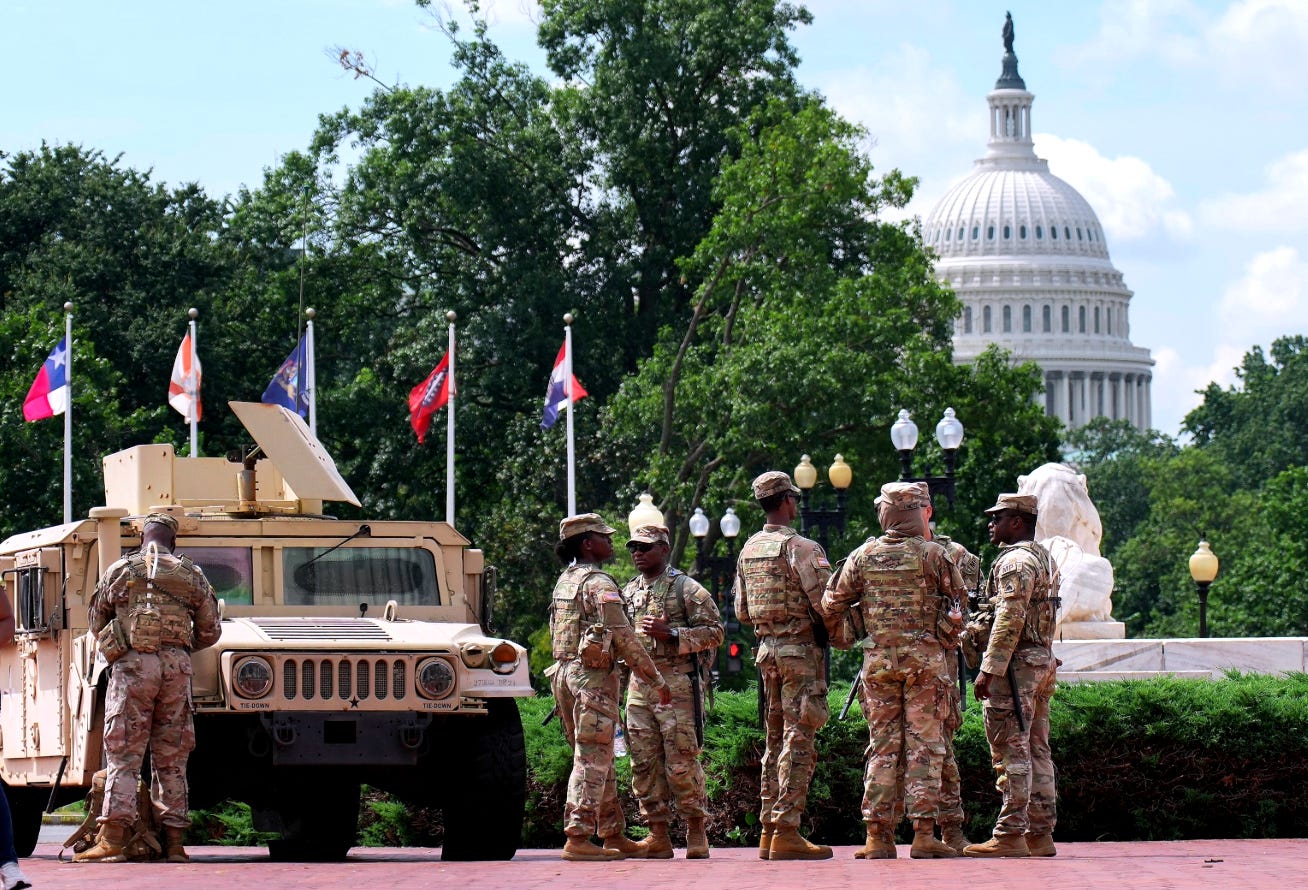
I spent a career planning campaigns, and the first question in the room was always the same: what does done look like, and how will we know. Not out of bureaucratic habit. Everything downstream flows from that answer – what you resource, what risk you accept, when you leave. Skip it and you’re not running a campaign anymore. You’re running an occupation and calling it something else.
The meter is running
I live twenty minutes from the Mall, and I’ve been walking that ground my whole working life. It used to be eighth-graders on field trips and a family from Ohio arguing over which Smithsonian to hit first. Now there are soldiers standing post at the Lincoln Memorial, and when visitors ask what they’re doing there, nobody has a clean answer.
As of late July there were roughly 4,600 personnel in the city from the District and 23 states and territories, with Georgia alone contributing about 800 – more than the D.C. Guard itself. The Defense Department told Congress the extension runs about $1.4 billion for fiscal 2027 through 2029, and that’s assuming only 2,500 troops stay. The Project on Government Oversight puts the full total closer to $3 billion. The Guard has also contracted $292 million for up to 2,000 apartment-style housing units, which isn’t what you buy for a surge. It’s what you buy for a garrison.
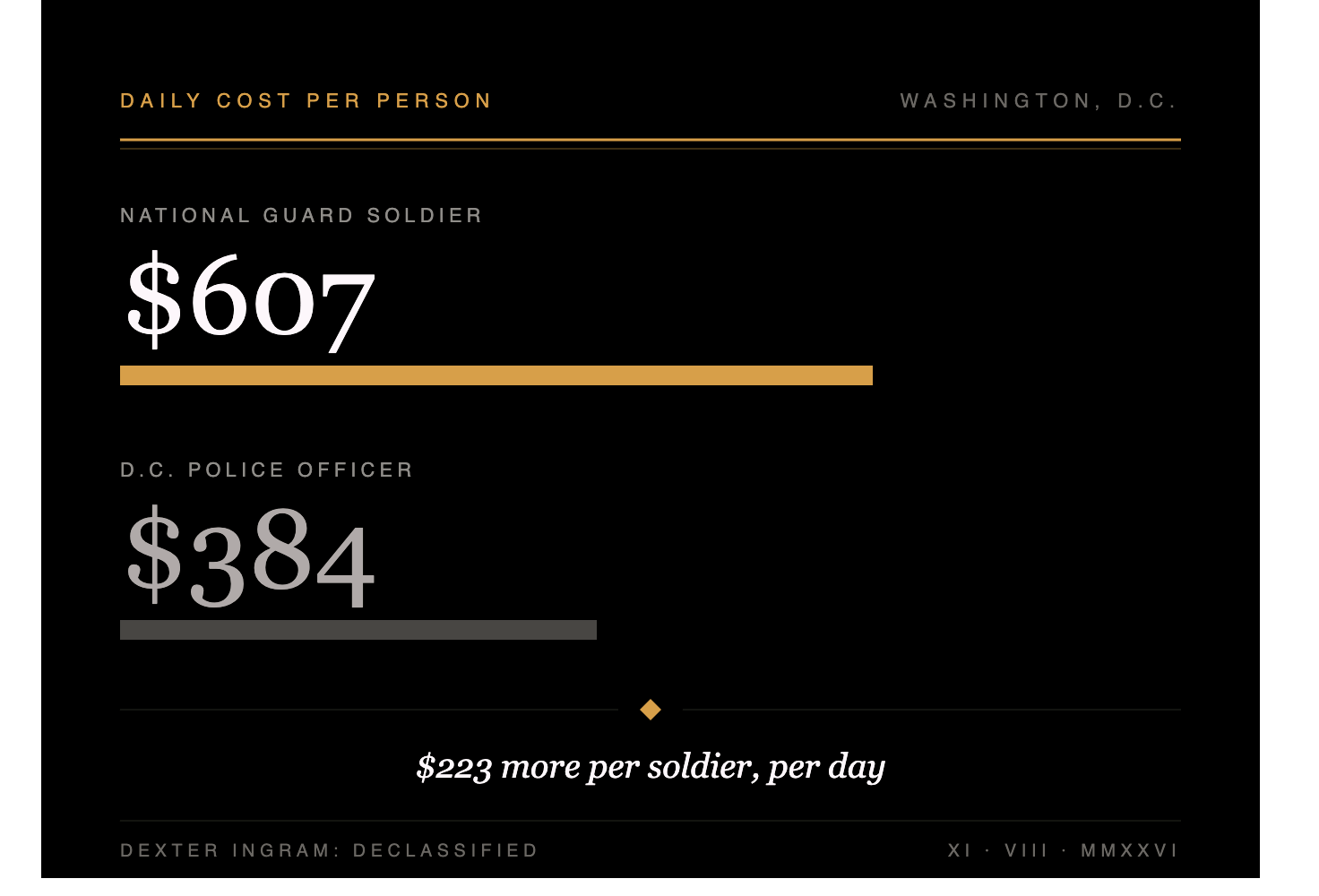
The daily math is worse. Each soldier runs $607 a day; a D.C. police officer costs the city $384. By this month the operation passes $600 million, more than the Metropolitan Police Department’s entire annual budget. And for that money, an analysis from the Niskanen Center found little measurable effect on violent crime, with the declines now cited as proof already underway before the first vehicle arrived.
Happy birthday, America

The city has been paying a second bill on top of the federal one. International visitation was forecast to fall more than five percent. Destination D.C. spent its shrunken budget on a campaign whose entire purpose was convincing Americans that their capital wasn’t a war zone. The Downtown BID logged tourism dropping after the mobilization and nearly 6,000 jobs lost, the first decline since 2020. Brookings found residents themselves pulling back from downtown – not visitors spooked by headlines, but people who live here deciding not to go.
Then came the 250th. The Great American State Fair drew scattered crowds and empty booths across sixteen days on the Mall, and the President’s own Fourth of July address played to visible gaps in the seating. We militarized the front lawn of the republic in time for its birthday and then wondered where everyone was. Museums are running half empty. Restaurants that survived the pandemic aren’t surviving this.
Same movie, two screens
Policing an American city and fighting Iran aren’t the same thing legally or morally, and I won’t pretend otherwise. But they’re being run the same way, and that’s what ought to worry anyone who does this for a living.
Both started from a premise instead of a plan. Neither has a terminal condition anyone can articulate. Both are being managed one escalation at a time by people who never worked backward from an end state because they never had one. And both are being funded out of readiness.
Robbing the reserve
Our stockpiles of key munitions have drawn down while talks stall and restart. Retired General Randy Manner, once a senior Guard official at the Pentagon, put the domestic side plainly: this money comes out of the accounts that buy fuel, food, lodging and training.
Every dollar spent standing a specialist next to a monument is a dollar not spent making a force ready for something we didn’t choose.
That’s the whole logic of the reserve component. It’s supposed to be available when the country actually needs it. Burning it on an open-ended domestic mission with no defined finish isn’t a security posture – it’s spending down the insurance policy to pay for lawn service.

In November, Specialist Sarah Beckstrom of the West Virginia National Guard was ambushed at a Metro station three blocks from the White House and killed. Staff Sergeant Andrew Wolfe was shot beside her and spent months in acute care. Both had been on orders in Washington since August. Soldiers accept risk – that’s the job, and they knew it walking in. What they’re owed in return is a mission somebody thought through. Driving toward zero isn’t that.
Guardsmen are also enforcing juvenile curfews and holding people until local police arrive to make the arrest. That’s a real break from the American separation of soldiers from routine policing, and it drops young troops into political fights they never enlisted for.
Send them home
A country secure in itself doesn’t garrison its own capital.
The strength of that place was never the fence line – it was that anyone could walk right up to it.
One year in, we’ve spent more than the police department’s whole budget, hollowed out a tourism economy during the 250th, produced no measurable effect on the problem we named, and drawn down readiness in two theaters at once. All of it in service of an objective that was never achievable, which is exactly why none of it ends.
There are real threats to this country. I spent my career on them. This isn’t one.
Subscribe annually and I’ll mail you a signed copy of one of my books – your pick. Details come in your welcome email.
Dexter Ingram is a counterterrorism expert who spent his career in national security. He led the State Department’s Office of Countering Violent Extremism, and oversaw the 89-nation Global Coalition to Defeat ISIS. He is the founder of IN Network and author of “National Security Careers: The Ultimate Guide to Breaking In” and “The Spy Archive: Hidden Lives, Secret Missions, and the History of Espionage.”
It is shocking to me how low the bar has reached. You don’t even walk into a meeting without being clear before hand of what you would like to achieve in that meeting, the ideal and everything acceptable working backwards from that. Yet large scale decisions like this and the current war were made without a realistic end goal. In my head I keep circling everything back to how successful a hijacked media has been in brainwashing enough people to vote for the least qualified candidate. This particular issue is in your capital, but in the UK we suffer the same ills. It is the same handful of people at the root of the problems worldwide. The answer? People like you and so many others who are doing this work and hopefully an audience with curiosity for the truth, that would steadily grow. The only thing that’s bigger than the influence of the billionaires is the power of the people.
Thank you Dexter for your service and commitment to our country. In order to have a healthy future citizens need to be informed with facts about the situation inside our government. Where changes need to happen to keep our democracy from falling into an autocracy or fascist state. It feels like we are at a tipping point where immediate action is needed to prevent the collapse of our republic.